
FOI Cases
Contents
Create a New Case
An FOI case can be created manually using the New Case button, or via email to new.case@your-eCase, where you will change the 'your-eCase' with the name of your eCase domain, for example new.case@organisation.ecase.co.uk or new.case@organisation.ecase.gsi.gov.uk. If you send the email from your own eCase email address, the case will appear in your My Work tab.
Find out more…
How to manually create FOI Cases
How to create FOI cases via email
Standard Lines
When you create a new FOI case, you have the ability to choose relevant Standard Lines of text that can be used as part of the response to the case on the Case Details screen. Standard Lines automatically appear based on the Key Terms, Subject or Group/Team assigned to the case, or can be manually selected.
Find out more…
How to add Standard Lines to a case
Link a Case
When a new case is added onto eCase you have the opportunity to search for any cases that are similar in nature to it. This can be through the key terms used or the contact details. It allows you to view historical information, provide consistent responses or see where multiple requests have been made by the same correspondent.
Find out more…
Back to Top
Watch a Case
You can watch a case at any point in the case history, or you can allocate other people as watchers. This allows you to keep track of cases that are of interest to you or other people. You can request for the cases to be shown on a Watching Cases tab on your Workbasket, or to receive email notifications as the case progresses.
Find out more…
Back to Top
Mandatory Clearances
Mandatory Clearances can be set on a case at any point during the case process. The clearances are highlighted so that the drafter is aware that the people/teams assigned in this area are required to quality check the case before a response can be sent and the case closed. Once the quality checks are accepted, the status of the mandatory clearances will be set to complete and the response can be sent.
Find out more…
How to add a Mandatory Clearance
Back to Top
Allocate a case
Once a case has been created, the next step is to allocate the case for investigation.
Find out more…
Back to Top
Acknowledge the receipt of the case
Once you are assigned as a drafter, the Acknowledgement section becomes available on the Case Details screen. The first step is to acknowledge that the correspondent has sent in a request.
A record of the Acknowledgement Email or Letter can be found at the bottom of the Case Details page under the Correspondence section.
Find out more…
Acknowledge the request via letter
Acknowledge the request via email
Back to Top
Clarify the request
When a case has been assigned to a drafter, if there is not enough information in the case details, then a request for more information can be sent to the correspondent. At this stage, the clocks will be paused and will not restart until the correspondent has sent in the required information.
Find out more…
Request clarification via letter
Request clarification via email
View a case in the Awaiting Clarification tab
Take Ownership of the FOI case from the Awaiting Clarification tab
Back to Top
Contribution
A contribution in eCase is a request for further information, by a case owner to an advisor or specialist. Refer to the Contribution section.
When a new contribution is requested, you have the option to select contribution types of:
- Request for Draft - where you are asking the contributor to draft the response to FOI case.
- Request for Information - where you are asking for information to assist you in drafting the response to the FOI case.
Find out more…
Contribute to a Case
Respond to a contribution
Reply to All from an email Contribution Request
Enter response yourself
Back to Top
Quality Assurance
A Quality Assurance (QA) request can be sent from eCase, via email, to have the response checked before sending out to the correspondent. This can be done using the Contributions/QA link, and then the New Quality Assurance Request. If the Standard Quality Assurance Request email template is used, the recipient of the QA can click on the approve or reject link directly from the email they have been sent. Refer to the Quality Assurance section.
Find out more…
Quality Assurance
Respond to a QA request
Back to Top
Prepare a Response
The Response screen guides you through the process of preparing a response. Click on the Prepare a Response link on the left menu.
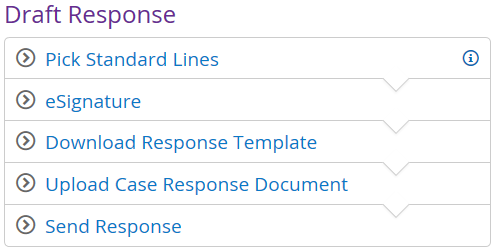
In the Prepare a Response screen, Pick Standard Lines, which are paragraphs of text that can be added to the response document when the mail merge [[STANDARD_LINES]] is used. These will be pre-populate in the response document when you download the response template in the Download Response Template section.
Once contributions have been received and the response document is complete. Go to the Upload Case Response Document section to add the response document to the case. Quality assurances can then be completed on the document.
Complete the FOI Outcomes, then go to Send the Response. An email response can be sent directly from eCase, or a record of the date a letter was sent.
Find out more…
How to Respond to a case
Send response out via email
Send response out via letter
How to record the FOI Outcome
How to close a case
Back to Top
Internal Reviews
The Internal Review screen has been improved.
- You can open an internal review when a case is open or closed.
- The Target Date automatically pre-populates when the Date Requested is selected.
- You can easily see the number of days remaining to investigate the internal review.
- You can assign the internal review to a team member from the internal review screen, whilst you keep control of the case.
- The Original Case Outcome and the Outcomes added in Reviews are split into different sections on the internal review screen making it easier to see and review the outcomes that are applied.
- A dedicated prepare a response link is available on the internal review screen. The response is tied into the specific internal review.
Find out more…
Create an Internal Review
Complete an Internal Review